
Army Spokesperson Colonel Aman Anand said troops from China's People's Liberation Army (PLA) 'violated' the consensus arrived at during military and diplomatic engagements on the ongoing standoff in eastern Ladakh, and carried out provocative military movements to change the status quo.

Another round of diplomatic talks under the framework of the Working Mechanism for Consultation and Coordination is expected to be scheduled soon.
The step was taken by both the sides as they wanted to avoid a repeat of June 15 violent face-off as the troops were in close vicinity.

The meeting started at around 11.30 am at Moldo on the Chinese side of Line of Actual Control (LAC) opposite Chushul to defuse the tensions in Eastern Ladakh sector due to Chinese military build-up, the sources said. This is the second meeting between the two corps commanders.
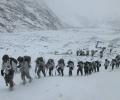
The Indian side has an edge over their Chinese counterparts in terms of battling the weather as a large number of them have already done duty in the Ladakh sector, including the Siachen glacier or other high altitude positions, sources said.

Outgoing Indian envoy to China Vikram Misri on Monday had a virtual farewell call on Chinese Foreign Minister Wang Yi during which he said that "certain challenges" had overpowered the vast opportunities in the bilateral ties last year and hoped that with continued communication the two sides would be able to resolve the current difficulties.

The two sides held diplomatic talks through video conference on the border standoff in midst of fresh details emerging that China has strengthened its position in several areas in eastern Ladakh including Galwan Valley where a violent clash on June 15 left 20 Indian soldiers dead.

China does not have to give up what it took in 2020, it will never give up its claim to Arunachal Pradesh, Ladakh and other areas, and it has all the time now to plan its next surprise, points out Lieutenant General Prakash Katoch (retd).

External Affairs Ministry Spokesperson Anurag Srivastava said India is committed to resolve all issues through dialogue, noting the way ahead to address the issue is negotiations.

Uttam Ghosh offers his take on the Rafales's arrival at a time when India's coronavirus crisis is getting worse.
The Indian side is expected to present specific proposals at the talks to deescalate tension in Pangong Tso, Galwan Valley and Demchok -- the three areas in eastern Ladakh where the two sides have been on a bitter standoff for last one month, the sources said.

India and China will complete the disengagement process in the Gogra-Hotsprings area in eastern Ladakh by September 12, the External Affairs Ministry said on Friday.
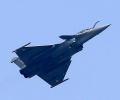
Sources said the exercise is aimed at checking the IAF's overall combat capability and military preparedness in the region.
The decisions were mentioned in a joint statement issued by the two armies late Tuesday, a day after the sixth round of Sino-India Corps commander-level talks that lasted for 14-hours.

'Tensions and dialogue are likely to go hand-in-hand with China.' 'The goal should be to cultivate power so that one can negotiate from a position of strength.'

The commanders' conclave in a forward area in Sikkim, which is close to the Line of Actual Control, comes amid the lingering border row in eastern Ladakh.

DRDO is offering a 30-35-tonne light tank that it says will be a match for what the army faces -- China's new Type-15 light tank.

The MEA spokesperson further said the actions and behaviour of the Chinese side since earlier this year along the LAC have been in "clear violation" of the bilateral agreements and protocols concluded between the two countries to ensure peace and tranquility on the border.
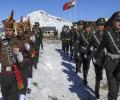
The sources said the mutual disengagement of troops at the two friction points is likely to be completed within two days, and that there has been 'substantial' withdrawal of forces by Chinese military from the areas.

Army chief General Naravane said the ongoing dialogue will sort out all the perceived differences between the two countries.

In an interaction with the commanders at their ongoing biannual conference, Singh reasserted the faith of the billion-plus citizens in the Indian Army as one of the "most trusted and inspiring organisations" in the country.
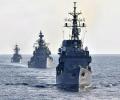
The Indian Navy is also ramping up its operational cooperation with various friendly naval forces like the United States Navy and Japan Maritime Self Defense Force in view of the fast evolving regional security landscape, they said.
The high-level talks came a week after 20 Indian Army personnel were killed in a violent clash between the two sides in Galwan Valley.

According to information, the Chinese side conveyed to the Indian mission its keenness to have a meeting between the two defence ministers.
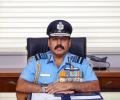
Air Chief Marshal Bhadauria was at the Leh IAF base on Wednesday where he reviewed operational preparedness of the force in effectively guarding the sensitive border areas in eastern Ladakh where Indian and Chinese armies have been on a nearly six-week standoff.

The move comes amid hectic diplomatic manoeuvring between the two countries over a host of issues like Nuclear Suppliers Group and designation of Masood Azhar as a terrorist by the United Nations.

Congress leader Adhir Ranjan Chowdhury aid that India must tackle Chinese aggression using all necessary means.
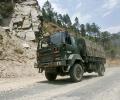
It is learnt that Defence Minister Rajnath Singh has conveyed to top military brass that there was no need for reviewing the implementation of any of the key projects along the Line of Actual Control (LAC) in Ladakh, Sikkim, Uttarakhand or in Arunachal Pradesh in view of the aggressive behaviour by Chinese troops in several sensitive areas.
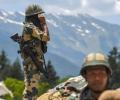
Gen Naravane said India is dealing with China in a "firm" and "non-escalatory" manner to ensure the sanctity of its claims in eastern Ladakh, and that it was even open to initiating confidence-building measures.

This is the first time that the defence ministry has admitted officially about the transgressions by the Chinese troops.

The batch of five experts will also play a role as interpreters between India and China sides during border personnel meetings, sources said.
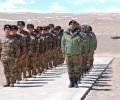
Chinese Foreign Ministry spokesman Wang Wenbin said this at his media briefing as he parried questions on India's assertion that consensus reached by the leaders on maintaining peace along the border cannot be swept under the carpet.
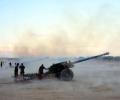
The Indian Army is enhancing the combat prowess of its artillery units along the frontier with China by procuring an array of weapons systems, including an additional batch of 100 K9 Vajra howitzers, swarm drones, loitering munitions and surveillance systems.

He said India had made matching deployments in terms of troops and infrastructure in its areas along the LAC and there was no way anyone would be able to behave in an aggressive manner again.

The 30-member committee, chaired by senior Bharatiya Janata Party leader and former Union minister Jual Oram and of which Rahul Gandhi is also a member,wishes to visit the eastern Ladakh region in the last week of May or in June.

His attack on the government came a day after Defence Minister Rajnath Singh assured Parliament that India has not conceded anything in the sustained talks with China and it will not allow even an inch of its territory to be taken away by anyone.
Indian military sources said no firearms were used in the clashes and that most of the injuries were sustained following stone-pelting and use of rods by the Chinese side.

It took India and the Indian Army to show to the world that enough is enough and to challenge the neighbourhood bully, he said.

The current geopolitical situation necessitates the Indian Air Force to prepare for intense and small duration operations at a short notice, Chief of Air Staff Air Chief Marshal VR Chaudhari said on Thursday.

He said that the government of India has never accepted this illegal occupation.
